

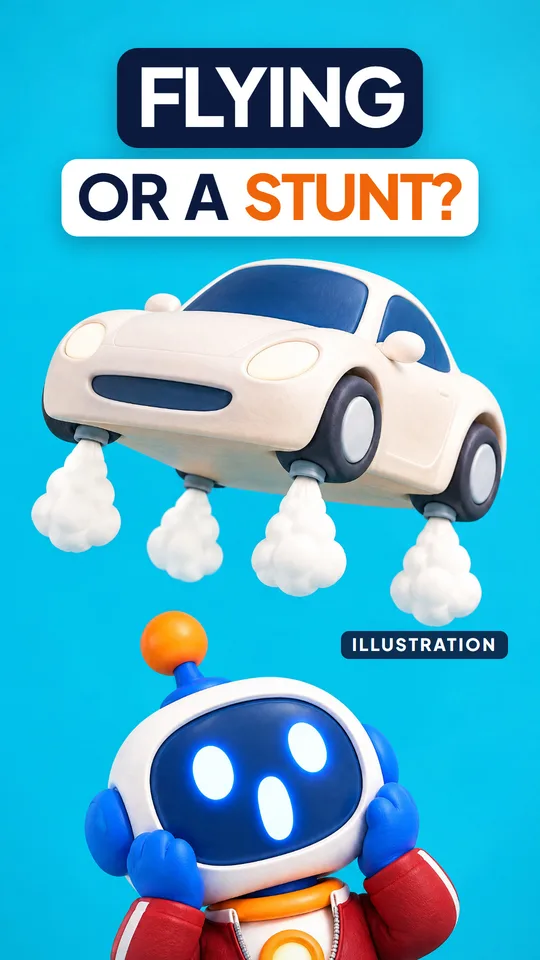
Can Tesla's New Roadster Really Fly?
Tesla has shown a Roadster getting airborne – but could you actually fly it to work? The demonstration on 15 October 2026 used cold-gas thrusters. The principle fits into a balloon: gas shoots one way, the vehicle is pushed the other – no combustion needed. But getting airborne is not the same as demonstrating a practical flying car: hovering needs continuous upward force against gravity, stored gas runs out, and you also need control and a safe landing. Taking off is only the beginning.
NOTE Based on Tesla's demonstration of 15 October 2026 and Tesla's own product page. According to Tesla, flight features are offered only on the invite-only "Rocket" trim, which is not approved for public road use. Tesla has published no flight time or flying range. The thruster animations are schematic illustrations, not Tesla's actual layout. Status: 18 October 2026.
Sources & further reading (6)
- Tesla – Roadster (official product page)
https://www.tesla.com/roadster - Reuters – Tesla's new Roadster turns in air with SpaceX thrusters (15 Oct 2026)
https://www.reuters.com/business/autos-transportation/tesla-set-unveil-next-generation-roadster-sports-ev-after-years-delay-2026-10-15/ - TechCrunch – Tesla reveals SpaceX-powered Roadster (15 Oct 2026)
https://techcrunch.com/2026/10/15/tesla-reveals-spacex-powered-roadster-that-flies-and-falls-with-style/ - NASA Glenn – Rocket Principles
https://www.grc.nasa.gov/www/k-12/rocket/TRCRocket/rocket_principles.html - NASA Glenn – Newton's Laws of Motion
https://www1.grc.nasa.gov/beginners-guide-to-aeronautics/newtons-laws-of-motion/ - NASA – Small Spacecraft Technology: In-Space Propulsion (Cold Gas)
https://www.nasa.gov/smallsat-institute/sst-soa/in-space_propulsion/